A God for Everything: Passover and the Judgement of Egypt

As Passover approaches it is important to understand that the Exodus is  the very backbone of the whole Bible. As the sun sets, we are going to turn our gaze toward a much older landscape: the Nile Delta. The Exodus was not merely a migration; it was a systematic, divine dismantling of a superpower and its entire spiritual infrastructure.

​A Land of Rivers and Rituals

​Ancient Egypt was a society built upon the rhythm of the Nile, an 850-mile-long oasis. Their entire success—their food, their military might, and their survival—depended on the river’s three seasons: Inundation, Sowing, and Harvest. It was a pagan society with a god for every facet of nature. These gods lived in temples and were treated like people: priests would wake them, feed them breakfast, and put them to bed at night after dinner.

​At the pinnacle of this system sat Pharaoh, viewed as the living embodiment or the fine focus of these gods. To challenge Pharaoh was to challenge the cosmic order of the most superstitious and proud nation on earth.

​As recorded in the ancient promises to Abraham:

Genesis 15:13–14: “And he said unto Abram, Know of a surety that thy seed shall be a stranger in a land that is not theirs, and shall serve them; and they shall afflict them four hundred years; And also that nation, whom they shall serve, will I judge: and afterward shall they come out with great substance.”


​The Battle of the Wills

​The conflict begins with a simple request from Moses and Aaron, met with Pharaoh’s infamous arrogance: “Who is the Lord, that I should obey his voice?”. To Pharaoh, the God of the Hebrews was a non-entity. This set the stage for a series of judgements designed to prove exactly who was in charge.

Exodus 12:12–13: “For I will pass through the land of Egypt this night, and will smite all the firstborn in the land of Egypt, both man and beast; and against all the gods of Egypt I will execute judgement: I am the Lord. And the blood shall be to you for a token upon the houses where ye are: and when I see the blood, I will pass over you, and the plague shall not be upon you to destroy you, when I smite the land of Egypt.”


​The Mystery of the Hardened Heart

​One of the most debated aspects of this narrative is the “hardening” of Pharaoh’s heart. In the original Hebrew, two distinct concepts are at play. The first, Kabad, means to make heavy or severe—a refusal to submit. This is used when Pharaoh hardens his own heart.

​The second, Chazaq, means to strengthen or make obstinate. This is used when God “hardens” Pharaoh’s heart. Essentially, God allowed the fullest expression of Pharaoh’s existing pride. If Pharaoh chose to be stubborn, God “strengthened” him in that choice to ensure the full weight of the lesson was felt by all.

Exodus 4:21: “And the Lord said unto Moses, When thou goest to return into Egypt, see that thou do all those wonders before Pharaoh, which I have put in thine hand: but I will harden his heart, that he shall not let the people go.”


​Judgement on the Gods by the Thousand

​The plagues were not random natural disasters; they were calculated strikes against the Egyptian gods who represented the forces of nature.

The following table compares the plagues mentioned in the recording to the specific aspects of Egyptian life and religion they challenged.

Plague Scripture Target of Judgement
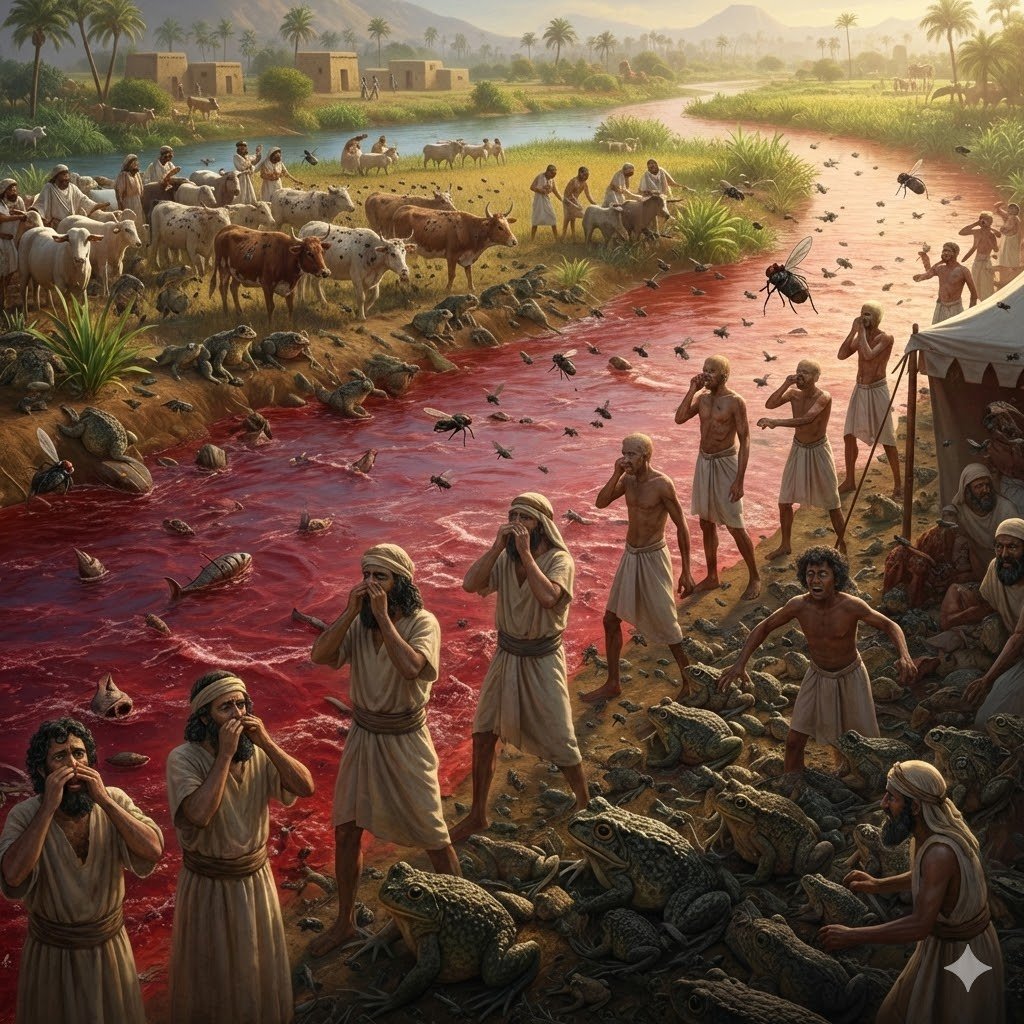
1. Blood Exodus 7:17-18 The Nile (Hapi/Osiris): The life-blood of Egypt became undrinkable. The fish, also worshipped, died, and the river stank.
2. Frogs Exodus 8:1-15 Heqet (Goddess of Fertility): Often depicted as a frog or a woman with a frog’s head. God turned their goddess into a nuisance that teemed in every house.
3. Lice Exodus 8:16-19 Geb (God of the Earth): The “dust of the earth” became lice. The magicians confessed, “This is the finger of God,” as they could not replicate it.
4. Flies Exodus 8:20-32 Khepri (God of Creation/Rebirth): Often associated with the scarab beetle. Swarms of flies corrupted the land, yet God “severed” the land of Goshen to protect His people.
5. Livestock Exodus 9:1-7 Hathor/Apis (Cattle Deities): A “severe pestilence” killed the Egyptian livestock, while not a single animal belonging to Israel died.
6. Boils Exodus 9:8-12 Isis/Sekhmet (Goddesses of Healing): Ashes from the furnace became boils on man and beast. The magicians could not even stand before Moses because of their own sores.
7. Hail Exodus 9:13-35 Nut (Goddess of the Sky): Unprecedented hail and fire destroyed every tree and shrub. Only in Goshen was there no hail.
8. Locusts Exodus 10:1-20 Serapia/Min (Protectors of Crops): Billions of locusts consumed what little the hail had left. This prompted the cry that Egypt was “destroyed” or “ruined”.
9. Darkness Exodus 10:21-29 Ra (The Sun God): Three days of thick darkness that could be felt. While Egypt was in pitch black, the children of Israel had light in their dwellings.
10. Firstborn Exodus 11-12 Pharaoh/Isis (Protector of Children): The ultimate blow against the “god” Pharaoh. Every firstborn in Egypt died, including Pharaoh’s own son.

The Finger of God: A Divine Deconstruction of Egypt’s Power

The ten plagues were not merely a series of unfortunate natural disasters; they were a systematic, divine dismantling of Egypt’s entire religious and social infrastructure. Behind each strike, God was executing judgement against “all the gods of Egypt,” proving that the forces of nature—which the Egyptians worshipped by the thousand—were entirely under His sovereign control.

Striking the Heart of the Nile

The conflict began at the Nile, the very life-blood of Egyptian success. By turning the river to blood, God struck at Hapi and Osiris, the deities believed to sustain the land’s fertility and transport. This first plague effectively “ruined” the nation’s primary resource, turning their source of life into a stinking reminder of their helplessness.

The Irony of the Sacred

The plagues often used the Egyptians’ own objects of worship as instruments of torment. The plague of frogs directly challenged Heqet, the frog-headed goddess of fertility. In a stroke of divine irony, the very creatures they held sacred became a pervasive nuisance, filling their homes and beds. Similarly, the lice and flies challenged Geb (the earth god) and Khepri (the god of creation), showing that even the dust and the air were obedient to the God of the Hebrews.

The Great Distinction

As the judgements intensified, a profound “division” emerged. While Egypt was ravaged by livestock pestilence, boils, and a terrifying hail that destroyed every shrub in the land, the land of Goshen remained a sanctuary of peace. This preservation served a specific purpose: to demonstrate that the Lord makes a difference between those who are His and those who are not.

The Final Sovereignty

The climax reached the very pinnacle of the Egyptian hierarchy. The plague of darkness directly eclipsed Ra, the sun god, while the death of the firstborn struck the “god” Pharaoh himself. Pharaoh had been warned that if he did not release God’s “firstborn” (Israel), his own son would pay the price. This final blow, followed by the destruction of the Egyptian army in the Red Sea, left no doubt: the pride of Egypt was crushed, and the sovereignty of the Lord was established for all generations to see.

​1. Water to Blood

​Turning the Nile to blood struck at the heart of what made the nation tick. It was like blowing up the M1, M6, M5, and M4 all at once.

Exodus 7:17: “Thus saith the Lord, In this thou shalt know that I am the Lord: behold, I will smite with the rod that is in mine hand upon the waters which are in the river, and they shall be turned to blood.”


​2. The Plague of Frogs

​The Egyptians worshipped frogs, yet God made the land teem with them until the people were stepping on their own “gods”.

Exodus 8:10: “And he said, Tomorrow. And he said, Be it according to thy word: that thou mayest know that there is none like unto the Lord our God.”


​3. Lice and the Failure of Magic

​By the third plague, Pharaoh’s magicians reached their limit, admitting they could not match this miracle.

Exodus 8:19: “Then the magicians said unto Pharaoh, This is the finger of God: and Pharaoh’s heart was hardened, and he hearkened not unto them; as the Lord had said.”


​The Great Distinction: Goshen

​As the plagues progressed, God began to make a “difference”. While Egypt was ravaged by flies, livestock disease, and boils, the land of Goshen—where the Israelites dwelt—remained unaffected.

Exodus 8:22–23: “And I will sever in that day the land of Goshen, in which my people dwell, that no swarms of flies shall be there; to the end thou mayest know that I am the Lord in the midst of the earth. And I will put a division between my people and thy people: tomorrow shall this sign be.”


​The message was clear: God knows those who are His. Whether it was the livestock disease or the terrifying hail that destroyed every shrub in Egypt, the Israelites were preserved.

Exodus 9:16: “And in very deed for this cause have I raised thee up, for to shew in thee my power; and that my name may be declared throughout all the earth.”


​The Final Blow

​After locusts stripped the land and darkness covered Egypt, the final judgement arrived. Pharaoh had been warned: let Israel go, or God would kill his firstborn son.

​Pharaoh’s refusal led to the ruin of his nation. His servants eventually pleaded with him: “Do you not yet know that Egypt is destroyed?”. But pride is a powerful anaesthetic. It wasn’t until the death of the firstborn and the subsequent destruction of the Egyptian army in the Red Sea that the lesson was finalised.

Exodus 14:30–31: “Thus the Lord saved Israel that day out of the hand of the Egyptians; and Israel saw the Egyptians dead upon the sea shore. And Israel saw that great work which the Lord did upon the Egyptians: and the people feared the Lord, and believed the Lord, and his servant Moses.”


​A Lesson for Today

​The Exodus teaches us that God does not need to do much to bring about a lesson; sometimes He simply removes His hand and allows our own pride to lead us to confusion. In our modern world, we may see the same lack of clear direction when God is sidelined.

​As we approach the Passover season, the call remains the same: to acknowledge the sovereignty of the only true God and to follow where He leads—leaving the pride of Egypt behind.
From Shadow to Substance: The Eternal Significance of the Passover

The story of the Passover is not merely a historical footnote or an ancient ritual; it is a profound narrative arc that spans the entirety of Scripture, from the earliest promises made to Abraham to the ultimate sacrifice of Jesus Christ. By examining the Passover through the lens of both the Old and New Testaments, we discover a theme of redemption, covenant, and an invitation into the very presence of God.

​The Foundation: A Covenant Cut in Faith

​The roots of the Passover reach back further than the exodus from Egypt, beginning in Genesis 15 with Abraham. Abraham believed in God’s impossible promises—that he would have a son by Sarah and descendants as numerous as the stars—and God accounted it to him as righteousness.

Genesis 15:6: “And he believed in the Lord, and He accounted it to him for righteousness.”

​When Abraham asked how he would know he would inherit the land, God initiated a solemn ceremony. In the Hebrew tradition, this was a Karath Berith—the “cutting” of a covenant. As the sun set, a “horror and great darkness” fell upon Abraham, and God revealed the future of his descendants.

Genesis 15:12–14: “Now when the sun was going down, a deep sleep fell upon Abram; and behold, horror and great darkness fell upon him. Then He said to Abram: ‘Know certainly that your descendants will be strangers in a land that is not theirs, and will serve them, and they will afflict them four hundred years. And also the nation whom they serve I will judge; afterward they shall come out with great possessions.’”

​This prophecy set the stage for the Exodus: a period of 400 years of affliction followed by divine judgment on their oppressors.

​A Promise Remembered: Judgment on the False Gods

​Centuries later, in Exodus 6, God declared that the time had come to act, specifically because He “remembered” His covenant.

Exodus 6:5–8: “And I have also heard the groaning of the children of Israel whom the Egyptians keep in bondage, and I have remembered My covenant. Therefore say to the children of Israel: ‘I am the Lord; I will bring you out from under the burdens of the Egyptians, I will rescue you from their bondage, and I will redeem you with an outstretched arm and with great judgments. I will take you as My people, and I will be your God. Then you shall know that I am the Lord your God who brings you out from under the burdens of the Egyptians. And I will bring you into the land which I swore to give to Abraham, Isaac, and Jacob; and I will give it to you as a heritage: I am the Lord.’”

​The ten plagues that followed were not random acts of nature; they were targeted strikes against the principal gods of Egypt. Each plague—from the turning of the Nile to blood to the plague of boils—hit a specific deity, culminating in a judgment against Pharaoh himself, who was seen as the embodiment of all Egyptian gods.

​The Passover Lamb: The Sign of Protection

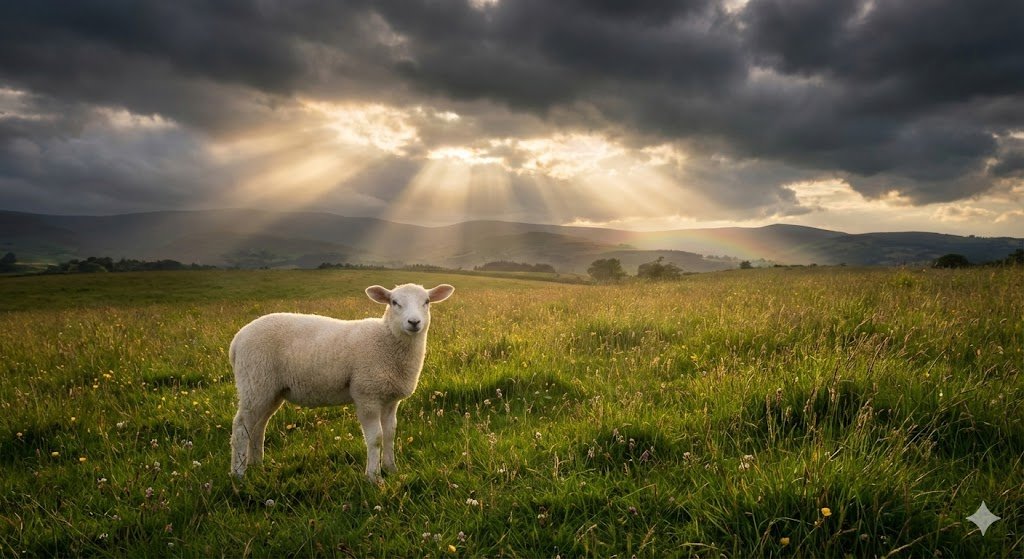
​The tenth and final plague—the death of the firstborn—necessitated the first Passover. God instructed the Israelites to take an unblemished lamb, kill it at twilight, and apply its blood to the doorposts of their homes.

Exodus 12:5–7: “Your lamb shall be without blemish, a male of the first year. You may take it from the sheep or from the goats. Now you shall keep it until the fourteenth day of the same month. Then the whole assembly of the congregation of Israel shall kill it at twilight. And they shall take some of the blood and put it on the two doorposts and on the lintel of the houses where they eat it.”

​The blood served as a protective sign. When the Lord saw the blood, He would “pass over” that house, sparing the firstborn within.

Exodus 12:12–13: “‘For I will pass through the land of Egypt on that night, and will strike all the firstborn in the land of Egypt, both man and beast; and against all the gods of Egypt I will execute judgment: I am the Lord. Now the blood shall be a sign for you on the houses where you are. And when I see the blood, I will pass over you; and the plague shall not be on you to destroy you when I strike the land of Egypt.’”

​The Ultimate Lamb: Christ Our Passover

​In the New Testament, the “shadow” of the Egyptian lamb meets its “substance” in Jesus Christ. John the Baptist explicitly identified Jesus as the fulfilment of this ancient type.

John 1:29: “The next day John saw Jesus coming toward him, and said, ‘Behold! The Lamb of God who takes away the sin of the world!’”

​This theme resonates through the book of Revelation, where Christ is depicted as a Lamb “as though it had been slain,” now standing in the midst of the throne of God. The New Covenant, established in His blood, offers more than just physical protection; it offers the remission of sins and eternal life.

​Reflection: Entering the Holiest

​For the believer today, the Passover is a time of deep self-evaluation. As we partake in the emblems of bread and wine, we are reminded of the unity we share in Christ’s body and the new life made possible through His sacrifice.

1 Corinthians 11:23–26: “For I received from the Lord that which I also delivered to you: that the Lord Jesus on the same night in which He was betrayed took bread; and when He had given thanks, He broke it and said, ‘Take, eat; this is My body which is broken for you; do this in remembrance of Me.’ In the same manner He also took the cup after supper, saying, ‘This cup is the new covenant in My blood. This do, as often as you drink it, in remembrance of Me.’ For as often as you eat this bread and drink this cup, you proclaim the Lord’s death till He comes.”

​The ultimate purpose of this New Covenant is to remove the barriers between us and the Divine. Through the “veil” of Christ’s flesh, we are invited to enter the very presence of the Father.

Hebrews 10:5–7: “Therefore, when He came into the world, He said: ‘Sacrifice and offering You did not desire, But a body You have prepared for Me. In burnt offerings and sacrifices for sin You had no pleasure. Then I said, “Behold, I have come—In the volume of the book it is written of Me—To do Your will, O God.”’”

​As we approach the Passover, the most vital question is not merely our adherence to law, but the state of our relationship with God. It is an invitation to get “down deep” within ourselves and ask the Father to show us how we are truly doing, allowing Him to strengthen that umbilical link between the Creator and the created.

The Highest Calling: Redefining the Way of the Peacemaker

In the modern world, the Nobel Peace Prize stands as the pinnacle of human achievement. Awarded annually to those who have done the most to foster fraternity between nations, reduce standing armies, or promote peace congresses, it carries immense prestige. For the recipient, the reward is often a mixture of global acclaim, significant speaking fees, and a lasting place in history. Yet, as distinguished as this earthly honour is, it remains a temporary one. Every recipient, from presidents to activists, eventually passes from the scene, and their influence—while significant—is finite.

There exists, however, a far greater calling and a more enduring reward. It is a vocation that does not require the approval of a committee in Oslo or the reduction of physical armaments. It is the biblical calling of the peacemaker. As recorded in the Gospel of Matthew:

“Blessed are the peacemakers, For they shall be called sons of God.” — Matthew 5:9 (NKJV)

To understand the weight of this promise, one must look beyond the surface-level definition of peace and explore the profound spiritual way of life it demands.

Beyond the Absence of Conflict: The Meaning of Shalom

In Western culture, we often define peace as a passive state—the absence of noise, the cessation of war, or a period of tranquility. This concept is reflected in the Greek word eirene. While valid, it represents only a fraction of the biblical concept of peace.

The Hebrew word used throughout the Old Testament is Shalom. Rather than a passive state, Shalom is a robust, active term signifying healthiness, completeness, and the intactness of a community. It is a sense of well-being that requires action. For example, in Genesis 29:6, when Jacob asks shepherds if his uncle Laban is “well,” the word used is Shalom. He isn’t asking if Laban is merely not fighting anyone; he is asking if his life is complete and flourishing.

True peacemaking, therefore, is not about building walls to separate conflicting parties. While the world often seeks peace through separation—sending “fractious kids” to different rooms or creating borders between nations—God’s peace builds bridges. It seeks the active well-being of the other person and the restoration of relationships.

The Blueprint for a Peaceable Kingdom

The vision of future peace provided in scripture is one of total transformation. The prophets describe a time when the “government of God” will be established under Jesus Christ—the Prince of Peace.

“For unto us a Child is born, Unto us a Son is given; And the government will be upon His shoulder. And His name will be called Wonderful, Counselor, Mighty God, Everlasting Father, Prince of Peace.” — Isaiah 9:6 (NKJV)

This government is characterized by “equity.” In a modern legal sense, equity refers to fairness, but in the original Hebrew context, it describes a path that is flat and straightforward—one that is easy for a person to follow without the “mountainous” obstacles of injustice or confusion.

This future era, often called the Millennium, promises a change so fundamental that even the nature of animals is altered. Isaiah 11:6 describes the wolf dwelling with the lamb and the leopard lying down with the goat. This is a world where “nothing shall hurt nor destroy,” and the earth is full of the knowledge of the Eternal as the waters cover the sea.

Peacemaking in a Hostile World: The Present Challenge

While the vision of the future is inspiring, the instructions for peacemaking are for the “here and now.” The Beatitudes were not written for a perfect world, but for believers living in the 21st century—under complex governments and within fractious societies.

The challenge of the peacemaker is that they are called to work in a hostile environment. Jesus noted that His first coming would not immediately bring universal peace, but would sometimes result in conflict even within households (Matthew 10:34-35). In this environment, the peacemaker must learn their craft.

Practical peacemaking involves several key disciplines:

  1. Prioritizing Reconciliation: The command in Matthew 5:23-24 is clear: if you are at the altar and remember a grievance with a brother, leave your gift. Reconciliation takes precedence over religious ritual.
  2. Loving the Enemy: Human nature suggests loving neighbors and hating enemies. The divine standard, however, is to pray for those who persecute you. This changes the perspective from wishing for an enemy’s demise to seeking their potential as a future son or daughter of God.
  3. Active Honesty: As Zechariah 8:16 states, “Speak the truth to one another; render in your gates judgments that are true and make for peace.” Peace cannot be built on falsehood or the avoidance of issues; it must be grounded in truth and justice.

The Ultimate Reward

The distinction between the Nobel Peace Prize and the biblical calling of a peacemaker lies in the source and nature of the reward. One is granted by men and offers earthly acclaim; the other is granted by the Creator and offers “sonship.”

Becoming a “son of God” is a position that cannot be purchased or earned through physical possessions. It is a gift extended through the sacrifice of Jesus Christ and the indwelling of the Holy Spirit. It is the standard held out for the family of God—to be perfect as the Father in heaven is perfect (Matthew 5:48).

By living as peacemakers today, we are training for a future role in a kingdom to come. We are learning to see others not as problems to be solved or enemies to be avoided, but as potential members of an eternal family. This is the peace of God which “passes all understanding”—a peace that guards the heart and mind, providing quietness and assurance forever.